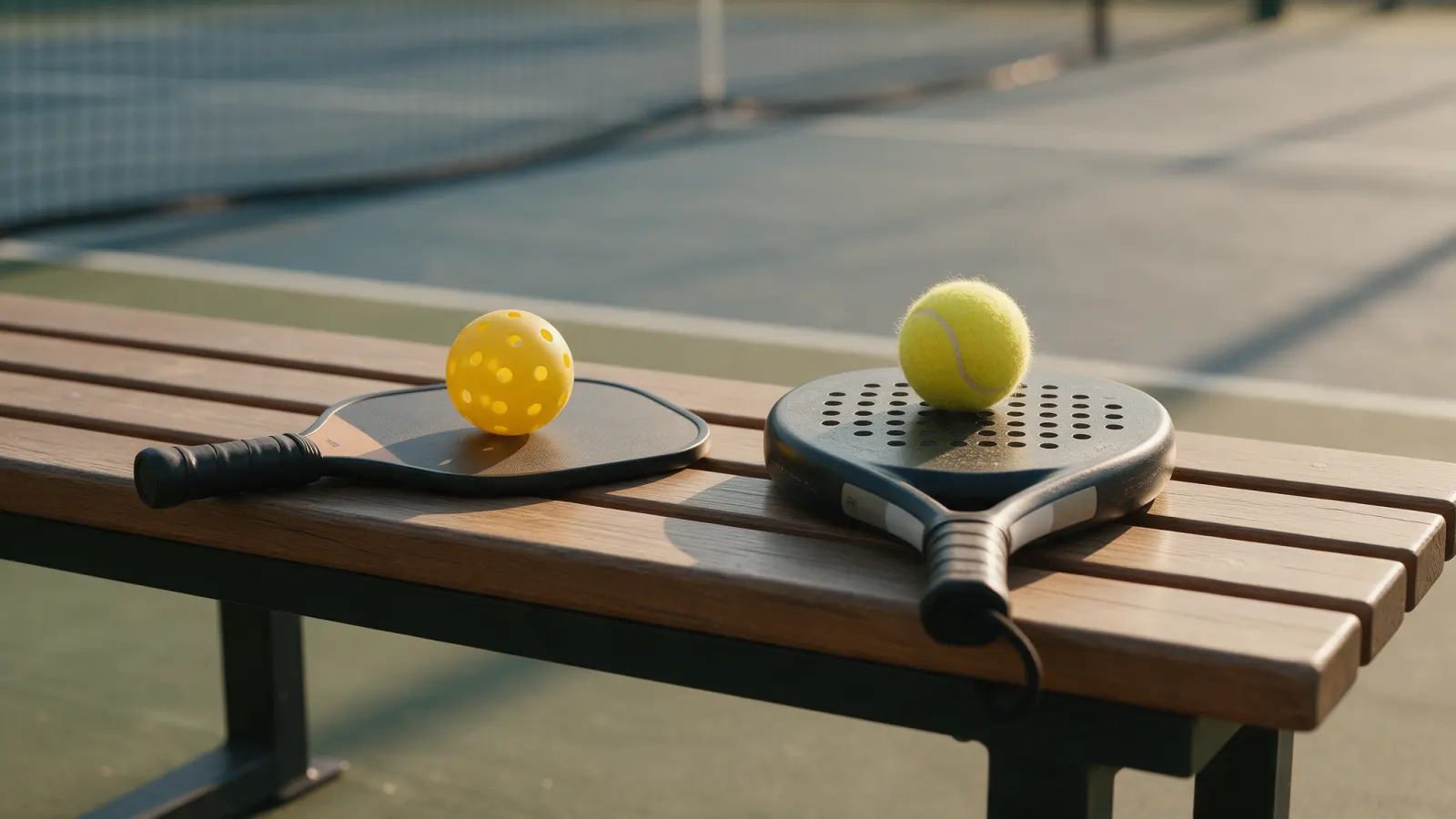
Pickleball vs padel: the differences, and which one to choose
Court, ball, racket, serve and scoring: what separates pickleball from padel, where each is played around the world, and which to choose to play or to build.
Both are doubles games with solid paddles and an underhand serve, which is where the likeness ends. Padel is played on an enclosed 20 × 10 m court with glass walls that stay in play, with tennis scoring and a felt ball. Pickleball is played on an open court a third of the size, with a plastic ball, a no-volley kitchen and its own scoring to 11. Pickleball needs lines and a net; padel needs a purpose-built court.
The differences at a glance
| Pickleball | Padel | |
|---|---|---|
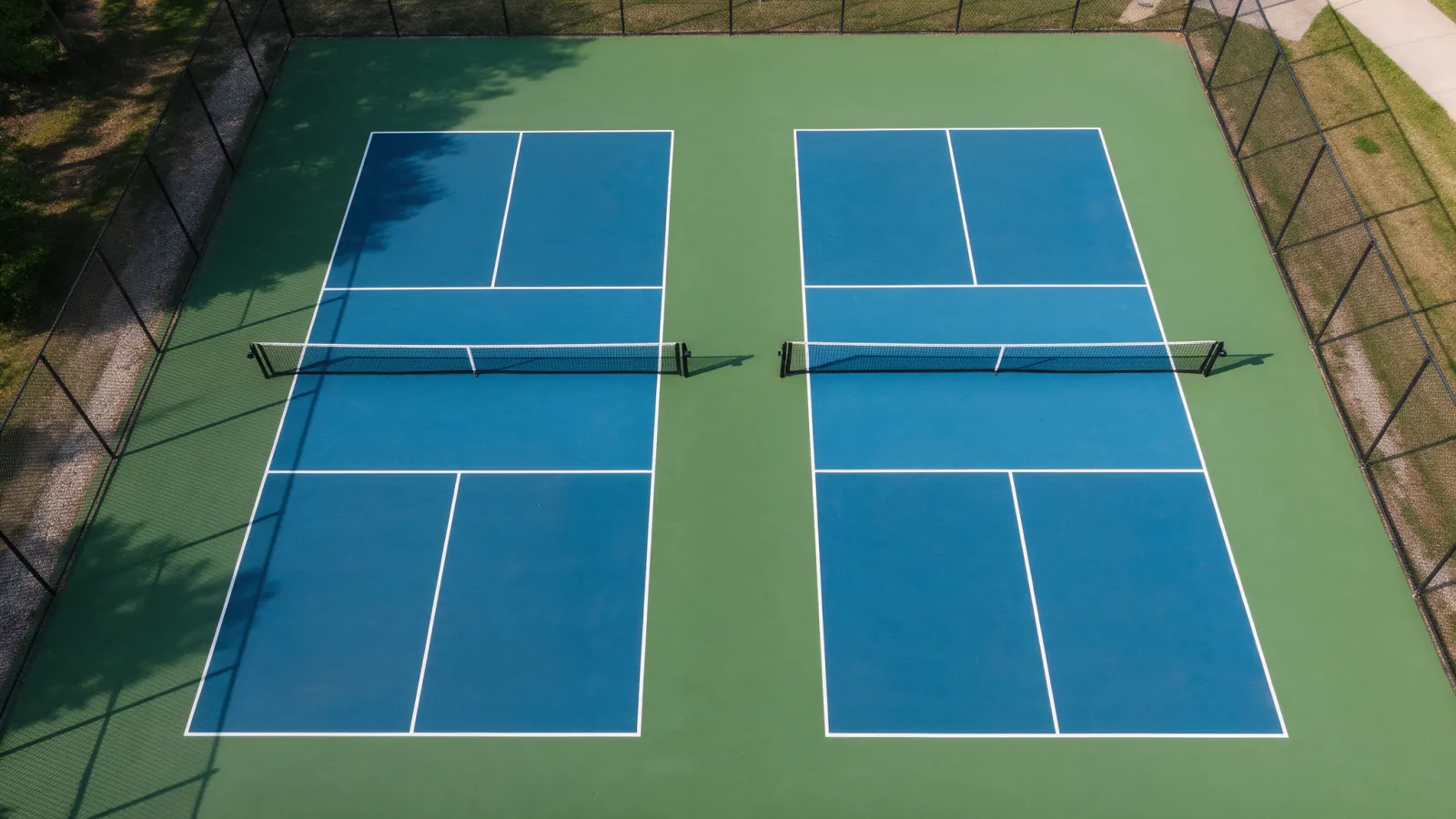
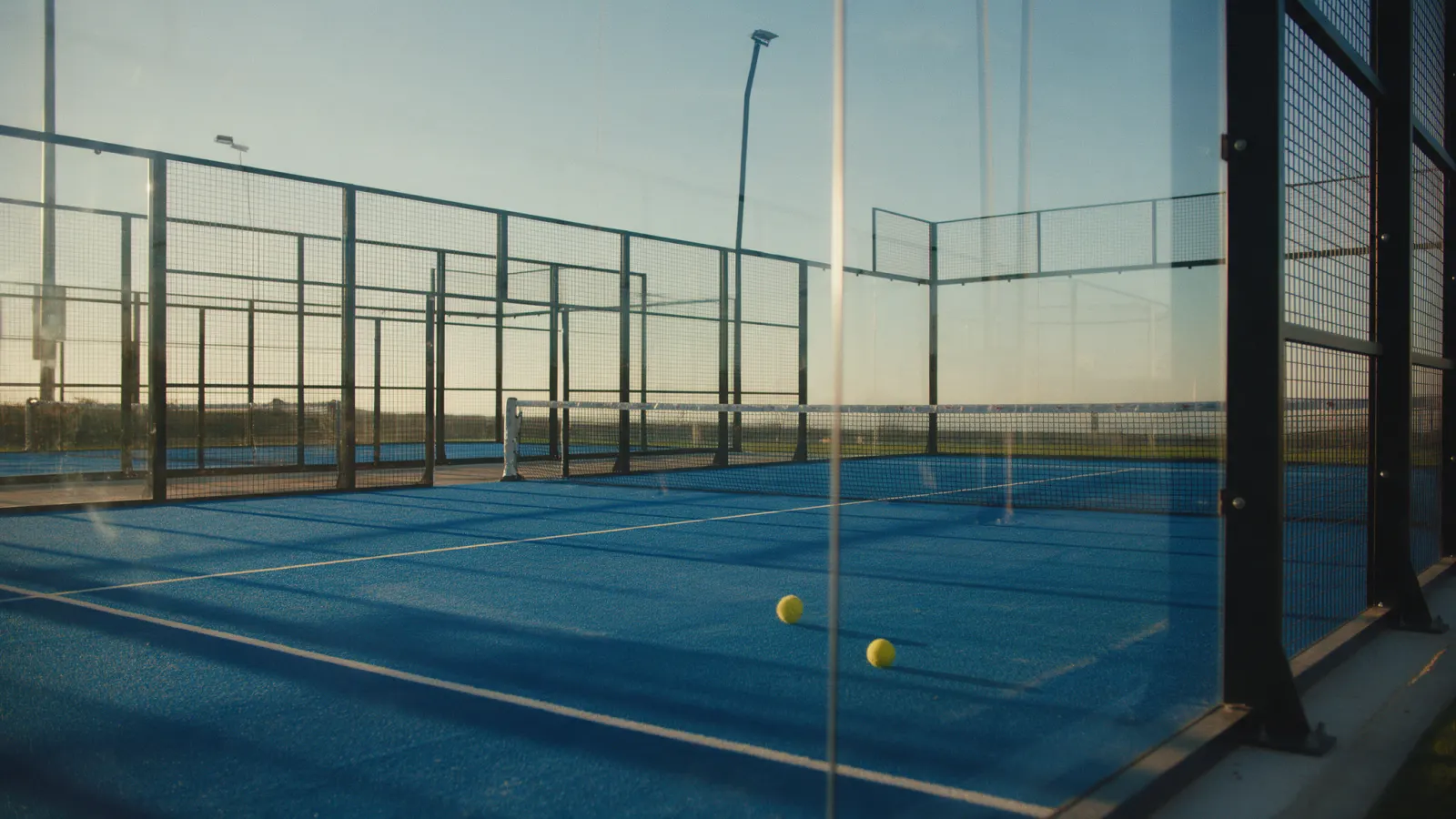
| Court | 13.41 × 6.10 m, open | 20 × 10 m, enclosed by glass and mesh |
| Walls | None | Part of the game, after the bounce |
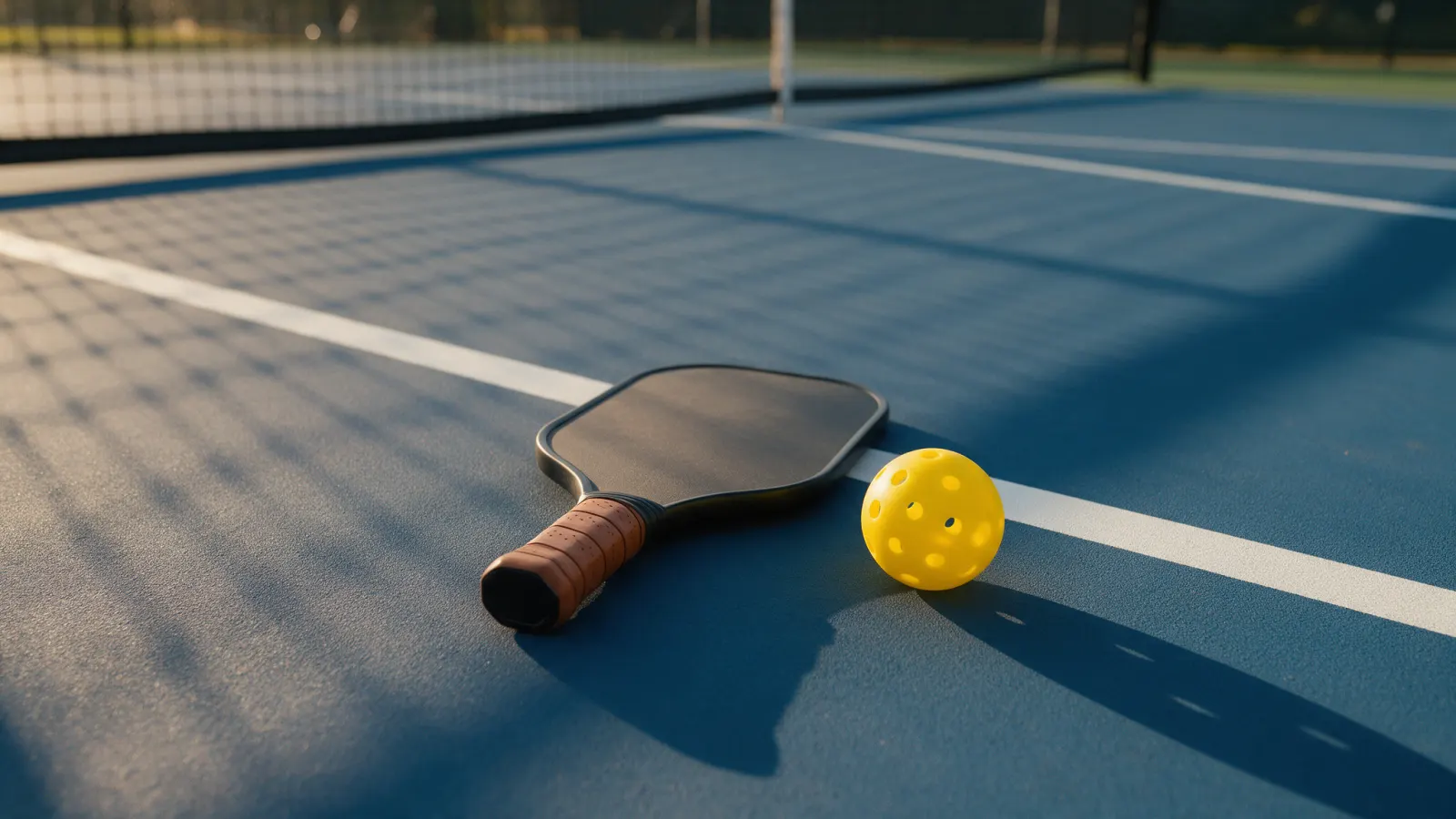
| Ball | Hollow plastic, with holes | Pressurised rubber and felt, 6.35–6.77 cm |
| Racket | Solid paddle, length + width ≤ 24 in | Perforated racket, ≤ 45.5 cm long, ≤ 38 mm thick |
| Serve | Underhand, one attempt, must clear the kitchen | After a bounce, at or below the waist, two attempts |
| Volleys | Not from the kitchen, and not before two bounces | Anywhere, except on the return of serve |
| Scoring | Only the server scores, games to 11 | Tennis scoring: 15, 30, 40, games and sets |
| Usual format | Doubles, singles common too | Doubles, almost always |
Two courts, drawn to the same scale
The padel court has more than twice the surface of the pickleball court (200 m² against about 82 m²), but the gap is bigger than it looks. Padel needs its structure, its glass and at least 6 m of clear height; pickleball needs lines and a net, on almost any flat, hard surface. The ITF’s footprint for an international tennis court, 36.57 × 18.29 m, is exactly four of the minimum pickleball playing surfaces of 9.14 × 18.29 m, which is why tennis courts are so often turned into four pickleball courts.
How it feels to play
Padel rewards patience. Letting the ball go past you, off the back glass, and playing it on the way out is the first shot anyone learns, and it makes rallies long even between beginners. The lob, which pushes the other pair off the net, is the key attacking shot. Tennis players adapt quickly: the scoring is theirs, and the strokes are close.
Pickleball is a game of touch at the kitchen line. The two-bounce rule forbids rushing the net, and the kitchen stops smashing from close range, so points are won with soft shots, the “dinks”, until someone lifts a ball too high. The ball is slow and the court is small, which is why people of every age play together from the first day.
The rules of each game are in the guides to padel rules and pickleball rules.
Where each one is played
The two sports did not spread in the same places. Our own search-demand research, run on 22 September 2026, shows it clearly:
- Padel is searched most, as a share of all searches in the country, in Spain, Denmark, the Netherlands, Portugal, Belgium and Argentina (Google Trends, last 12 months).
- Pickleball leads in the Philippines, Singapore, Malaysia, Vietnam, Hong Kong, Canada and the United States.
- In the United States, “pickleball” is searched about 673,000 times a month, against 110,000 for “padel”. In the United Kingdom, the two are level, at about 135,000 each (Google Ads, monthly average).
Over five years, worldwide interest in padel has more than doubled and interest in pickleball has grown about sixfold (Google Trends, weekly index, first and last twelve weeks of the period).
Which one to choose
| If you are… | Start with |
|---|---|
| A tennis player who wants a social doubles game | Padel: same scoring, close strokes |
| New to racket sports, or playing with children or grandparents | Pickleball: slow ball, small court |
| A club with tennis courts and no budget for building | Pickleball: lines and portable nets |
| A club or investor building a new venue | Look at your market: padel leads across much of Europe and in Argentina, pickleball in North America and Southeast Asia |
Many clubs end up offering both. In the booking system, every court carries its own sport, so padel, pickleball and tennis courts share one booking grid, each court labelled with its sport.
Sources
- USA Pickleball, Official Rulebook, 2026 edition, and International Padel Federation (FIP), Rules of Padel, edition applied from 1 January 2026: court, ball, racket, serve and scoring. Read on 22 September 2026.
- ITF, Rules of Tennis 2026, appendix: court footprints.
- Search demand: Google Ads monthly search volumes and Google Trends, retrieved through DataForSEO on 22 September 2026 for 37 countries.
Frequently asked questions
Is padel harder than pickleball?
Different rather than harder. Pickleball is quicker to pick up: a slow ball, a small court, a simple serve. Padel takes a few sessions to read the glass, and rewards tennis players, whose scoring and strokes it shares.
Can you play pickleball on a padel court?
Not properly. The padel court is enclosed by walls that are not part of pickleball, and its lines do not match. Pickleball courts go on open surfaces: tennis courts, sports halls, car parks.
How many pickleball courts fit on a tennis court?
Four, at the minimum playing surface of 9.14 by 18.29 m each: together they take exactly the footprint of an international tennis court, 36.57 by 18.29 m.
Is the scoring the same?
No. Padel uses tennis scoring (15, 30, 40, games, sets). Pickleball games go to 11, won by two, and only the serving side scores.