Badminton court dimensions and markings (singles and doubles)
A badminton court is 13.40 by 6.10 m (44 by 20 ft): singles width, short and long service lines, net height, and the new 15-point scoring coming in 2027.
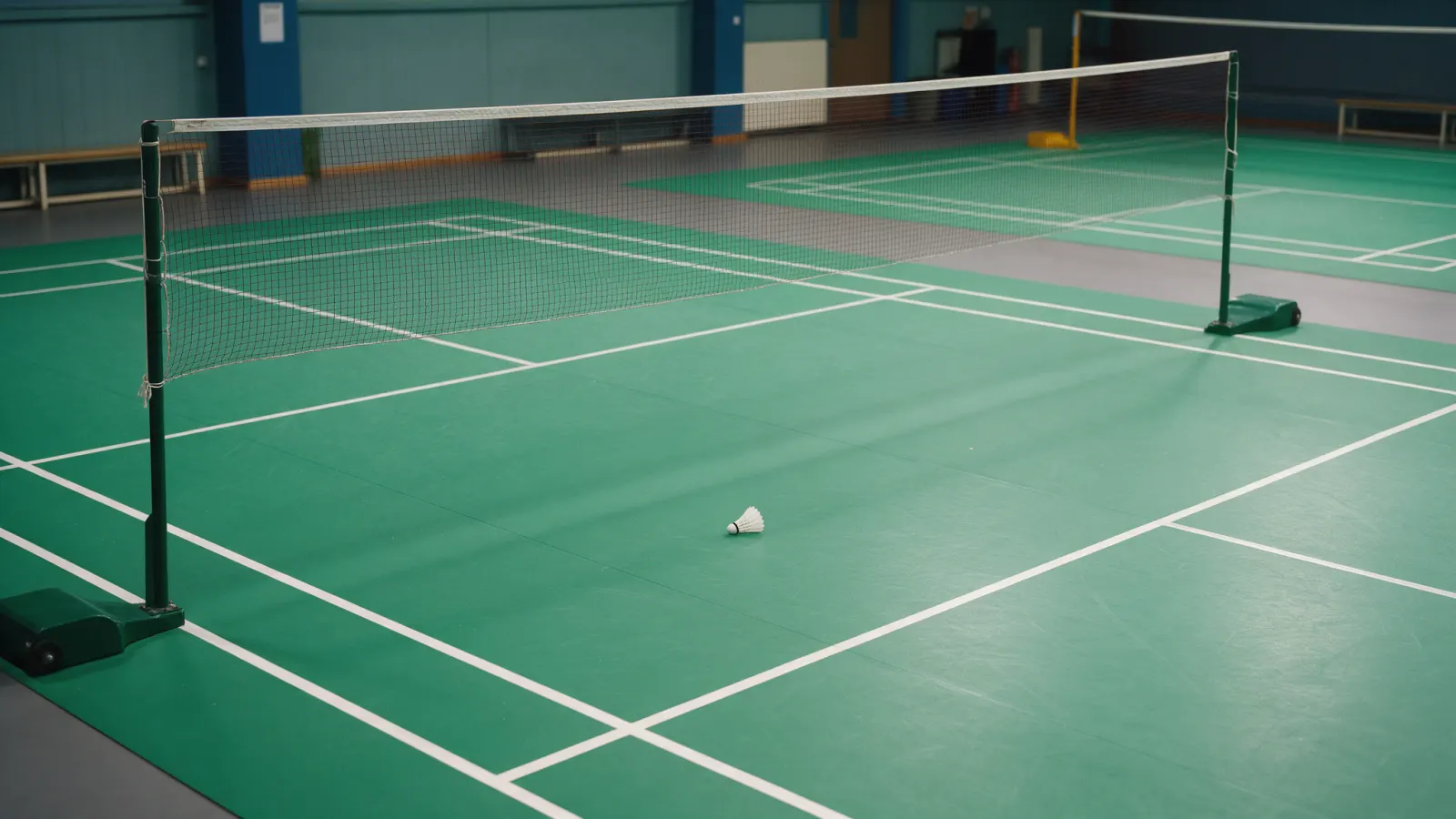
A badminton court is 13.40 m long and 6.10 m wide for doubles (44 by 20 ft), and 5.18 m wide for singles (17 ft). The short service line is 1.98 m from the net; in doubles, the long service line is 0.76 m inside the back boundary. The top of the net is 1.524 m above the floor at the centre and 1.55 m over the doubles sidelines. Lines are 40 mm wide and belong to the area they mark.
- 13.40 mLength of the court (44 ft)
- 6.10 mDoubles width (20 ft)
- 5.18 mSingles width (17 ft)
- 1.98 mNet to short service line (6½ ft)
- 1.524 mNet height at the centre (5 ft)
- 40 mmWidth of every line
What each line is for
A badminton court carries more lines than it seems, because singles and doubles share one court but not the same boundaries, and the serve has its own.
| Line | Where | What it does |
|---|---|---|
| Doubles sideline | Outer long lines, 6.10 m apart | The side boundary in doubles |
| Singles sideline | Inner long lines, 5.18 m apart | The side boundary in singles |
| Back boundary line | Each end, 6.70 m from the net | The back boundary in singles and doubles |
| Short service line | 1.98 m from the net | A serve must reach beyond it |
| Doubles long service line | 0.76 m inside the back boundary | In doubles, a serve must not land beyond it |
| Centre line | From the short service line to the back | Splits the left and right service courts |
The result is that the service court is long and narrow in singles (to the back line, singles width) and short and wide in doubles (to the doubles long service line, doubles width). After the serve, the whole court is in play: the full length, and the singles or doubles width.
Lines are 40 mm wide and are part of the area they define: a shuttle landing on a line is in. The BWF recommends white or yellow lines, easy to tell from the floor.
The net and the posts
The top of the net is 1.524 m from the floor at the centre and 1.55 m over the doubles sidelines. The net itself is 760 mm deep, of fine dark cord, and the posts, 1.55 m high, stand on the doubles sidelines, for singles as well as doubles.
The serve, and why the lines matter
Under the current Laws, the shuttle must be hit from below: the whole shuttle must be below 1.15 m from the court surface at the moment it is struck. The server and the receiver stand in diagonally opposite service courts, and the serve must land in the receiver’s service court, beyond the short service line.
Scoring, and the change coming in 2027
Under the Laws in force today (version 5.0), a match is the best of three games of 21 points, with rally scoring: every rally wins a point, whoever served. At 20-all, a side must lead by two; at 29-all, the 30th point wins.
The BWF has already published the next version of its Laws, in force from 4 January 2027: games will go to 15 points, a two-point lead will be needed from 14-all, and the 21st point will win at 20-all. Matches stay the best of three games. A club running its own ladder can switch whenever it likes; sanctioned events follow the date.
The hall around the court
The lines are only part of the space: players need room behind the back line and beside the sidelines, and a shuttle lifted high needs ceiling height. National federations and the BWF publish their minimums for competition halls, and they vary with the level of play, so check the ones that apply to you before fitting courts into a hall. Several courts side by side need a gap between them, which is often what sets how many fit.
Badminton and pickleball on the same floor
A pickleball court (13.41 × 6.10 m) is almost exactly the size of a badminton doubles court (13.40 × 6.10 m). The kitchen of pickleball, 2.13 m deep, sits close to the short service line of badminton, 1.98 m from the net. That is why sports halls often carry both sets of lines in two colours: see the guide to pickleball court dimensions.
Sources
- Badminton World Federation (BWF), Laws of Badminton, version 5.0 in force since 26 April 2025: Law 1 (court and equipment), Law 7 (scoring), Law 9 (service). Read on 22 September 2026.
- BWF, Laws of Badminton, version 6.0, in force from 4 January 2027 (new scoring), and BWF Statutes section 4.1.6, Imperial measurements. Read on 22 September 2026.
Frequently asked questions
What are the dimensions of a badminton court?
13.40 m long (44 ft) and 6.10 m wide (20 ft) for doubles; 5.18 m wide (17 ft) for singles. The same court is used for both, with two pairs of sidelines.
How high is a badminton net?
The top of the net is 1.524 m (5 ft) above the floor at the centre and 1.55 m over the doubles sidelines.
Why are there two back lines on a badminton court?
The outer one is the back boundary for all play. The inner one, 0.76 m inside it, is the doubles long service line: in doubles, a serve must not land beyond it.
Is badminton scoring changing?
Yes. Under the BWF Laws in force today, games go to 21 points. The next version, in force from 4 January 2027, moves to games of 15 points, still best of three.