Pickleball rules: how to play, serve and keep score
Pickleball rules explained simply: the serve, the two-bounce rule, the kitchen, three-number scoring and the faults, checked against the 2026 official rulebook.
Pickleball is played on a court 20 by 44 feet, with solid paddles and a perforated plastic ball, usually in doubles. The serve is hit underhand and diagonally. The ball must bounce once on each side before anyone may volley. Nobody may volley from the kitchen, the 7-foot zone on each side of the net. Only the serving side scores, and a game goes to 11, won by 2.
- 20 × 44 ftThe court, for singles and doubles alike
- 7 ftThe non-volley zone, each side of the net
- 2 bouncesBefore the first volley of a rally
- 11 pointsTo win a game, by a margin of two
- 1 serveA single attempt, underhand, diagonally
- 3 numbersThe doubles score: yours, theirs, server
The court and the kit
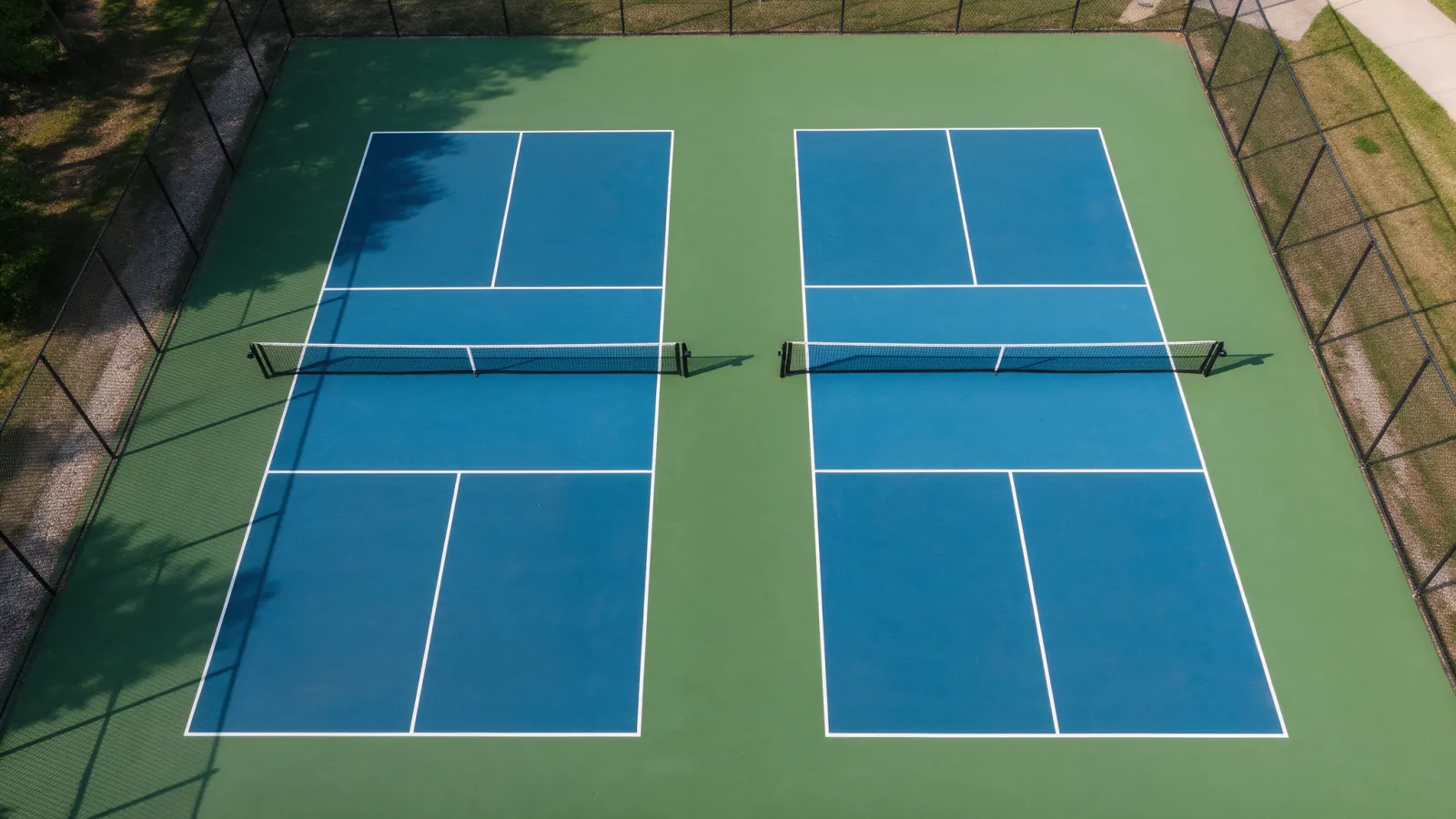
The court is 20 feet wide and 44 feet long (6.10 by 13.41 metres), the same size for singles and doubles. The net is 36 inches high at the sidelines and 34 inches at the centre. On each side, the 7 feet nearest the net form the non-volley zone, the kitchen; behind it, a centre line splits the court into two service courts. The full measurements, and how to draw courts on a tennis court, are in the guide to pickleball court dimensions.
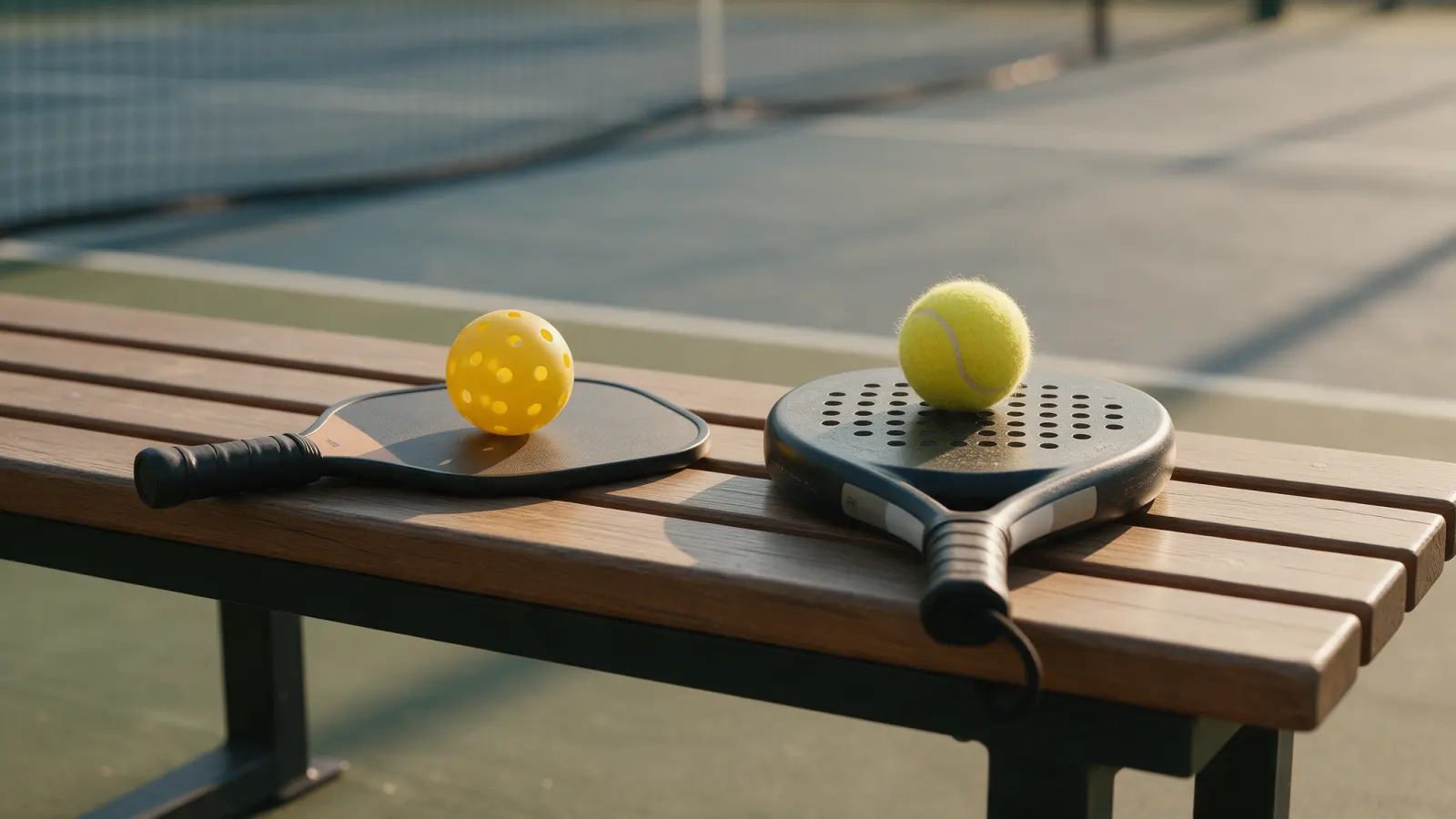
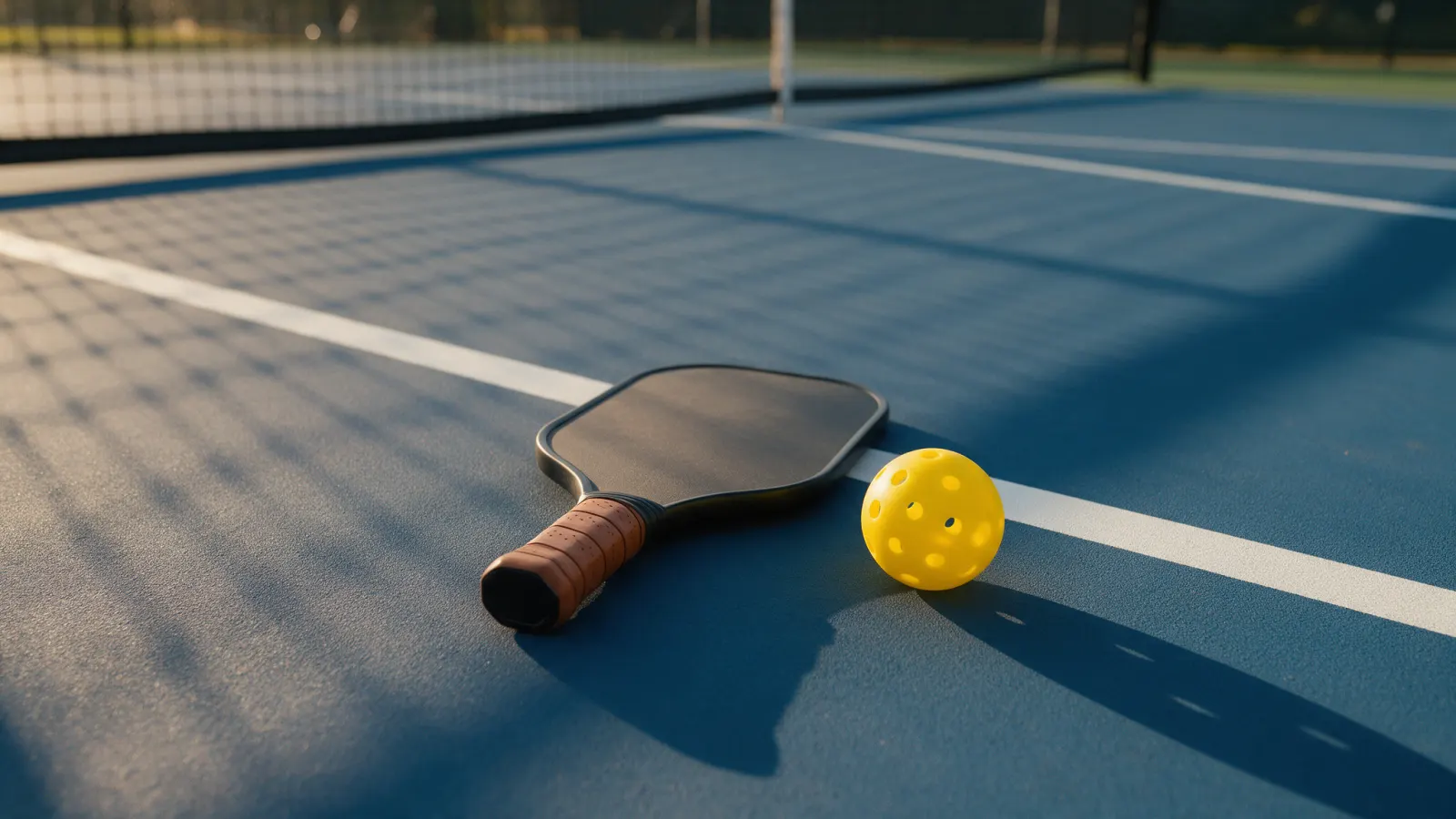
The paddle is solid, with no strings. Its length plus its width may not exceed 24 inches, and its length alone 17 inches; there is no limit on thickness or weight. The ball is hollow plastic with holes, which is what keeps it slow enough for long rallies.
The serve
The server stands behind the baseline and serves diagonally, into the service court opposite. The serve must clear the kitchen: a serve that lands on the kitchen line is a fault, while a serve on the baseline, the sideline or the centre line is good. There is a single attempt, and a serve that touches the net and still lands in the right service court is in play.
Two ways of serving are allowed:
- The volley serve, hit out of the hand. Three conditions at the moment of contact: the arm moves in an upward arc, the head of the paddle is not above the highest part of the wrist, and the ball is no higher than the server’s waist.
- The drop serve. The ball is released from a natural height, not thrown or pushed, and hit after it bounces. The upward-arc and wrist conditions no longer apply, which makes it the easiest serve to learn.
The two-bounce rule
The return of serve must bounce before it is played, and so must the serving side’s next shot. Only after those two bounces, one on each side, may players volley. The rule takes away the serve-and-volley and the net rush that would otherwise decide every point.
That third shot is the famous “third-shot drop”: a soft ball into the opponents’ kitchen that lets the serving pair move up to the net while the others have to let it bounce or dig it out of their feet.
The kitchen
A volley is a ball hit before it bounces. It may not be played by a player standing in the non-volley zone or touching its line, and the rule holds after the shot too: if momentum carries you into the kitchen after a volley, the point is lost, even once the ball is dead.
The kitchen is not forbidden ground. A player may step in at any time to play a ball that has bounced, and must simply be out of it, both feet, before volleying again.
Keeping score
Only the serving side scores. A game is played to 11 points and must be won by two; tournaments sometimes play to 15 or 21. When the serving side loses a rally, the serve passes to the other side, which is called a side out.
In doubles, both partners serve before the serve changes sides, except at the start of the game, where the first serving team has one server only. That is why the score is called with three numbers, the serving side’s score, the receiving side’s score, then the server’s number, and why a game starts at “zero, zero, two”. In singles, the score is two numbers, and the server serves from the right when their own score is even, from the left when it is odd.
How a rally is lost
| Situation | Result |
|---|---|
| The ball lands out, or fails to clear the net | Fault |
| The serve lands in the kitchen or on its line | Fault |
| A volley before the ball has bounced once on each side | Fault |
| A volley with a foot in the kitchen or on its line | Fault |
| The ball bounces twice before you play it | Fault |
| You touch the net with your body or your paddle | Fault |
A fault by the serving side ends its turn, or passes the serve to the partner in doubles. A fault by the receiving side gives the serving side a point.
Your first game
- Use the drop serve. It removes two of the three conditions of the volley serve and is just as legal.
- Return deep and move up. The receiving side has the advantage of reaching the kitchen line first: a deep return buys the time to get there.
- Stop at the line. Wait at the kitchen line, not in the kitchen. Most beginners’ faults are a foot on that line during a volley.
- Call the three numbers before each serve. It settles who serves from where, and every argument about the score.
Sources
- USA Pickleball, Official Rulebook, 2026 edition: court and paddle (3.A, 3.B, 3.D), scoring (4.A), serving sequence (5.B), score calling (6.B), the serve (7.C, 7.D, 7.E), line calls on the serve (8.C), the non-volley zone (9), the two-bounce rule (10.A). Read on 22 September 2026.
Frequently asked questions
What is the kitchen in pickleball?
The non-volley zone: the 7 feet on each side of the net. You may not volley while standing in it or touching its line, but you may step in to play a ball that has bounced.
Can you hit a volley on the return of serve?
No. Under the two-bounce rule, the return of serve must bounce, and so must the serving side’s next shot. Volleys are allowed only after those two bounces.
What does “zero, zero, two” mean?
It is how a doubles game starts: zero for the serving side, zero for the receivers, and server number two, because the first serving team gets only one server at the start of the game.
Is a serve that touches the net replayed?
No. Under the current USA Pickleball rules, a serve that touches the net and lands in the correct service court is in play. There is no let on the serve.
How many points is a game of pickleball?
Usually 11, won by a margin of two. Tournaments sometimes play games to 15 or 21. Only the serving side can score.